The illustrator who taught the spoken word
Who was Florence Scovel Shinn?
Florence Scovel Shinn (1871 to 1940) was a New Jersey born illustrator turned New York teacher of what she called spiritual law, and she is remembered for The Game of Life and How to Play It, the small book she published herself in 1925. Her whole teaching rests on one idea, that words spoken with faith come back to the speaker as events, so she filled three short books with ready-made statements to say aloud and with stories of the people she said they helped. We split all three books into chapters, counted her words and checked the quotes that circulate under her name, which lets you read what she actually wrote and decide for yourself.
Contents
Every page in this section
- 01The Game of Life, 1925The Game of Life and How to Play It, 1925, summarized chapter by chapter, with her exact quotes, our counts and the free PDF and audiobook.
- 02The Wand, 1928Your Word Is Your Wand, 1928, counted section by section: where its 222 affirmations sit, what she meant by the wand and where to read it free.
- 03The Secret Door to Success, 1940The Secret Door to Success, her 1940 book, chapter by chapter, with her exact words and what changed since her first book in 1925.
- 04The Power of the Spoken Word, 1945The Power of the Spoken Word appeared in 1945, after Shinn's death. What the book is, why we leave its lines unquoted, and how to tell them apart.
- 05Her books and the PDFEvery Florence Scovel Shinn book by year, which ones are public domain, where to read them at no cost, and our free PDF of her best lines.
- 06AffirmationsFlorence Scovel Shinn affirmations in her exact words, counted and sorted for money, love, health, work and guidance, with the stories behind them.
- 07Quotes, checkedFlorence Scovel Shinn quotes set beside her three books line by line, with book and chapter, plus the shared lines that are not in them.
- 08Her life and deathFlorence Scovel Shinn's death in 1940, what the obituaries say, and her life before the books, from art school and Everett Shinn to magazine illustration.
What she wrote about, book by book
Her three books came out over fifteen years, and her vocabulary moved with them. We counted a handful of her key words in each one, whole words only, in the public domain transcriptions we quote from.
| Word or phrase | The Game of Life, 1925 | Your Word Is Your Wand, 1928 | The Secret Door to Success, 1940 |
|---|---|---|---|
| love | 64 | 18 | 2 |
| subconscious | 56 | 6 | 15 |
| "for example" | 51 | 16 | 3 |
| intuition or hunch | 13 | 11 | 33 |
| Bible | 4 | 0 | 19 |
| "under grace" | 8 | 24 | 10 |
| affirmation | 12 | 9 | 15 |
The first and last books are about the same length, near 21,000 words each, so those columns compare directly. In 1925 she explains a theory of the mind and proves each point with a client story, which is why the phrase "for example" appears 51 times in it. By 1940 the stories carry less of the load, the subconscious gets roughly one in four of the mentions, and the advice leans on following hunches and reading Bible stories as lessons. Love, her biggest subject in 1925 with a whole chapter of its own, appears twice in the last book. The middle book stands apart because it is a pocket list of statements sorted by need, and that is where "under grace" piles up. Counts come from typed transcriptions, so a slip in the typing could move a number by one or two.
Three books in fifteen years
The Game of Life and How to Play It came first, ten chapters that set out her rules, from giving and receiving to what she called the Divine Design. Three years later she answered requests from readers with a sequel built almost entirely of affirmations. That sequel, Your Word Is Your Wand, runs to fewer than 9,000 words and sorts its statements under 29 headings, from Success to Rheumatism. Most of its pages are lists rather than chapters. Her last book in her lifetime, The Secret Door to Success, holds fourteen chapters of sermons on Bible stories and ends with a reading of Snow White. She died in October 1940, and even that book's date is a small puzzle, because the copy we quote prints 1941. A fourth title came out in 1945, half a decade after she died, and because we could not confirm its copyright status we describe The Power of the Spoken Word without quoting it.
Her affirmations, sorted by need
Most people arrive here looking for something to say. The 1928 book alone holds 222 by our count, one for each block she fenced off with a ruled line, and more than a third of them sit under two headings, Success with 48 and Faith with 38. The sorted lists start on our page of Florence Scovel Shinn affirmations, with her own instructions for using them. That page has a section each for money, love, work, health, and fear and guidance, every line quoted with its book and chapter. Her methods come next, here on this page, from casting the burden to asking for a lead.
Her techniques, step by step
Every method she taught starts from one habit, speaking a carefully worded statement about the outcome you want and then acting as though it has already arrived. She wrote "for example" 70 times across her three books, and nearly every technique below reaches the reader as a client's problem followed by the exact words she gave them. No study we could find tests whether any of it changes events.
The spoken word comes first, because she believed every sentence a person repeats sets a rule for them. Her proof is a father who always missed his streetcar and a daughter who always caught hers, each repeating a different sentence about it for years. Affirmations follow from that, and she was strict about the wording. One student who asked for work got plenty of it and was never paid, so the pay had to go into the statement. Her other rule for wording was to give thanks instead of pleading.
One should not plead or supplicate, but give thanks repeatedly, that he has received.The Game of Life and How to Play It, ch. 10, Denials and Affirmations
Casting the burden was the method she called the easiest for herself. The student gives the worry over to the "Christ within", her name for the superconscious mind, with the words "I cast this burden on the Christ within, and I go free," and keeps at it until the picture clears.
The statement should be made over and over and over, sometimes for hours at a time, silently or audibly, with quietness but determination.The Game of Life and How to Play It, ch. 6, Casting the Burden
Her formula for asking opens with "Infinite Spirit, open the way", six times in her books, and always asks for the "divine selection", the right home or partner, never one the student has already picked. After asking, the student waits for a lead or hunch and follows it, like the woman in chapter 10 who felt pulled toward a pink enamel paper cutter and bought it as a vote of confidence before her money arrived.
He should act only through intuition, or definite leads.The Game of Life and How to Play It, ch. 10, Denials and Affirmations
Preparing for the answer came next, in her teaching. A wife set a place at the table every day for a husband who had left, and a woman who wanted Christmas money bought wrapping paper and seals first.
Continually "making-believe," impresses the subconscious.The Game of Life and How to Play It, ch. 6, Casting the Burden
Blessing the person who seems to stand in the way belongs to her law of nonresistance, which says that fighting a bad situation keeps it in place.
"Bless your enemy, and you rob him of his ammunition."The Game of Life and How to Play It, ch. 4, The Law of Nonresistance
Almost every request then closes with a phrase beginning "under grace", which we counted 42 times in her books, and she began adding it after one request was answered in a way that hurt.
People also search for a Shinn "command" and a 17 minute version of it, and neither is a method in her three books. She quotes Isaiah's "command ye me" and calls the Lord's Prayer a form of command and demand, and the only length she ever gives is "sometimes for hours" for casting the burden. Her statements for each need are collected on her affirmations page.
What she meant by denials
A denial, in her teaching, is a statement that refuses a problem any reality "in Divine Mind" before an affirmation puts the good in its place. The pattern is always the same. She names the trouble, declares it has no place in Divine Mind, then states the opposite as already true. Her closing 1925 chapter is titled Denials and Affirmations, yet the word denial turns up only once in the running text of her three books, and "I deny" opens a statement just 8 times.
One should always follow a denial with an affirmation.The Game of Life and How to Play It, ch. 10, Denials and Affirmations
Here is every "I deny" statement we found, with where it sits.
| Her denial | Where |
|---|---|
| I deny loss, for two thousand dollars a woman lost on an unwritten deal | The Game of Life, ch. 8 |
| I deny this appearance of disease, said over the phone for a man she never met | The Game of Life, ch. 10 |
| I deny loss, for a lost pencil | Your Word Is Your Wand, Loss |
| I deny debt, three times | Your Word Is Your Wand, Debt |
| I deny fatigue | Your Word Is Your Wand, Health |
| I deny any appearance of disorder, for a dog | Your Word Is Your Wand, Animals |
The illness and fatigue lines are her accounts of her own practice, and we make no health claim for them. Her most personal denial has no "I deny" in it at all. She says she spent a long while believing one particular event always brought disappointment, and she broke the belief by asserting "There are not two powers, there is only one power, God" before calling the event a happy surprise (The Game of Life, ch. 3).
Denials never stood in for practical steps in her stories. To the woman owed a thousand dollars she said "You must work on yourself, not the man," and in the same books she tells students to pay their bills cheerfully. The labeled list that ends her first book mixes both kinds of statement, eleven entries under headings from Prosperity to Freedom from all Bondage.
Every plan my Father in heaven has not planned, shall be dissolved and dissipated, and the Divine Idea now comes to pass.The Game of Life and How to Play It, ch. 10, Denials and Affirmations
The Divine Design
By the Divine Design she meant a plan she believed each person already has waiting in Divine Mind, a place only they can fill and a task meant for no one else. She called asking for it a person's highest demand, and the idea runs through all three books under four related names, which we counted: Divine Right 26 times, Divine Design 20, Divine Plan 17 and Divine Selection 10.
Infinite Spirit, open the way for the Divine Design of my life to manifest; let the genius within me now be released; let me see clearly the perfect plan.The Game of Life and How to Play It, ch. 9, Perfect Self-Expression or the Divine Design
The plan, as she drew it, has four corners, which she called "the square of life": health, wealth, love and what she named perfect self-expression. That last one is work so absorbing it feels almost like play. She warned that asking for it could shake things up, and she told of one woman whose affairs looked as if a cyclone had struck before new conditions settled in.
Her 1928 book gives the idea a picture from nature.
Just as the perfect picture of the oak is in the acorn, the divine pattern of his life is in the super-conscious mind of man.Your Word Is Your Wand, The Divine Design
Two stories carry the teaching. In the first, a man after class handed her one cent of the seven he owned and asked her to speak the word for his self-expression, and a year later he came back with a position in a distant city and a roll of bills. In the second, a woman had a sudden thought that a Chinese cabinet belonged on one wall of her new apartment, found one in an antique shop priced at a thousand dollars, offered the two hundred that came into her mind, and got it at that price a few days later.
Some of the chapter belongs to its decade. She writes that a woman's perfect self-expression may lie in marriage and keeping a home, and she also tells parents never to force a career on a child. She did not want students to picture the plan by force. The design, she said, arrives as flashes of inspiration once it has been asked for, and the student's job is to hold the picture that comes without wavering.
Her stories and statements for work and calling are gathered on her affirmations page, with the rest of the Divine Design lines from Your Word Is Your Wand.
Her words, checked
Plenty of quotes credited to her online are close to what she wrote and a few are nowhere in her books. We pulled the 120 most shared quotes on her Goodreads page on November 26, 2026 and searched each one in her three books. Of those, 79 match word for word, 13 are close with small changes, and 28 are missing from all three. The top quote on that list is a smoothed version of her boomerang line from the chapter on karma, with the wording quietly modernized. The full list sits on our page of Florence Scovel Shinn quotes, real wording next to the shared one.
Where she fits
She is usually filed under New Thought, a US movement built on the idea that the mind shapes health and fortune, yet the phrase never appears in her three books. The writer she does name is the Russian philosopher Pyotr Ouspensky, whose Tertium Organum she quotes in 1925 and again in 1940.
Ouspensky states, in "Tertium Organum," that "love is a cosmic phenomenon,"The Game of Life and How to Play It, ch. 7, Love
That puts her on the same shelf as Neville Goddard, who names Ouspensky twice in the talks on our Hidden Mystics Map. Decades later the self-help author Louise Hay called her an early influence, in a profile the Times Magazine ran in 2008. Neither she nor Neville mentions the other in anything we hold, and their methods differ in useful ways.
Shinn vs Neville Goddard
Her methods and those of Neville Goddard share a premise, that whatever you keep fixed in your mind turns up in your life. They overlapped by one year in print. Her three books came out between 1925 and 1940, and his first, At Your Command, appeared in 1939, the year before she died. The tools they handed students differ, and the vocabulary shows it.
Shinn's tool is the spoken word. Students say a worded statement, aloud or silently, repeat it, give thanks, and follow the next hunch. Neville's tool is assumption. He told people to imagine a brief scene that could only take place if the wish were already granted, while drowsy and close to sleep, until it feels like something real.
We set our counts of her three books, about 51,100 words, beside the site's index of his 10 books and 310 talks, 1.57 million words. The counts show what each one talked about and say nothing about whether either method works.
| Word | Shinn, 3 books | Neville, books and talks |
|---|---|---|
| affirmation, singular | 40 | 11 |
| demand | 27 | 12 |
| thanks | 41 | 34 |
| assumption | 0 | 633 |
| imagination | 23 | 3,257 |
Read as rates, the gap is wide. Shinn wrote "affirmation" about 8 times per 10,000 words, and Neville used it about 7 times per million. He used "imagination" about 21 times per 10,000 words to her 4 or 5. Both lean on the Bible, though in different ways. Shinn uses verses as proof texts for a rule, while Neville, for whom human imagination was God, read scripture in that light.
Two decades before her first book, William Walker Atkinson put a third version into print, with thought as a vibration that draws its match. His 1906 book Thought Vibration is free here, and it reads more like training for willpower and daily habit than a guide to wording or imagining.
Before she taught
For more than a decade before the books she drew for a living. She studied art in Philadelphia at the Pennsylvania Academy, met the painter Everett Shinn there, and married him in 1898. Her drawings of comic, tender figures ran in Harper's and other magazines. In 1903 the Society of Illustrators took her in as an associate, nineteen years before it admitted women as full members. They divorced in 1912, and the rest of her story, including her last weeks at 1136 Fifth Avenue, is on her biography page.
Free to take with you
We pulled her best lines into one book you can keep. In Her Own Words sorts her affirmations, quotes and methods by what you need, from money and love to health, guidance and fear, with its source printed under every line. It closes with a short list of famous quotes that turn out to be paraphrases. Get it free on the page that lists all her books.
Real vs legend
| Claim | Status |
|---|---|
| She published The Game of Life herself in 1925. | Real · Wikipedia and the text archive both record it |
| She was an illustrator before she taught. | Real · Society of Illustrators associate, 1903 |
| She was married to the painter Everett Shinn. | Real · married 1898, divorced 1912 |
| She was a New Thought teacher. | Partly · the label is other people's, and her books never use it |
| She was a law of attraction teacher. | Partly · the phrase appears once, in her 1940 book |
| The Power of the Spoken Word was written as her fourth book. | Unclear · printed only after her death, in 1945 |
| The stories in her books prove the method. | Unchecked · the people are unnamed and the accounts are hers |
Questions
What people ask
Who was Florence Scovel Shinn?
She was an American artist and writer from Camden, New Jersey, born in 1871, who illustrated books and magazines before she became a teacher and lecturer on metaphysics in New York. She wrote three books in her lifetime, starting with The Game of Life and How to Play It in 1925, and her life ended in New York in October 1940.
What is Florence Scovel Shinn best known for?
Her first book, The Game of Life and How to Play It, is the title people know, and her short affirmations are the part they repeat. Lines such as "Infinite Spirit, open the way" come from her books and circulate widely online, often with the wording changed.
Was Florence Scovel Shinn part of the New Thought movement?
Historians and publishers place her there, because she taught that thought and the spoken word shape a person's life. She never uses the words New Thought in her three books, though, and the only modern thinker she quotes by name is the Russian writer Pyotr Ouspensky.
Where should a beginner start with Florence Scovel Shinn?
Most readers start with The Game of Life and How to Play It, because her later books refer back to it and it explains the ideas behind the affirmations. It is short, about 21,000 words, and free to read because its copyright has expired in the United States.
How long did Shinn say to repeat an affirmation?
She gave no fixed count or clock time. Her rule was to keep repeating, silently or aloud, until the doubt lifted, and she added that a person with perfect faith would need to say it only once.
How do you word a denial the way Shinn did?
She named the problem, said it had no place in Divine Mind, and then followed straight on with an affirmation of the good she wanted. Her debt statement, for one, denies that any debt exists in Divine Mind and ends by sending the other person love and forgiveness.
What did Shinn mean by the Divine Design?
She meant a life plan she believed already exists for every person in what she called Divine Mind, covering health, wealth, love and perfect self-expression. Students asked for it with "Infinite Spirit, open the way for the Divine Design of my life to manifest," and then watched for leads.
Is Florence Scovel Shinn's teaching the same as Neville Goddard's?
They share the belief that inner states shape outer events, and the methods differ. Shinn taught spoken affirmations followed by thanks and action on hunches, while Neville taught assuming the feeling of the wish fulfilled through an imagined scene, most often while drowsy at bedtime.
Sources
- The Game of Life and How to Play It (1925), Your Word Is Your Wand (1928), The Secret Door to Success (1940; the transcription prints a 1941 Shinn Press imprint), Internet Sacred Text Archive: https://sacred-texts.com/nth/shinn/index.htm
- Word counts and phrase counts: our own, from those transcriptions, November 26, 2026.
- Goodreads quote check: our own, from https://www.goodreads.com/author/quotes/56422.Florence_Scovel_Shinn, pulled November 26, 2026.
- Biography, dates and Society of Illustrators membership: her Wikipedia article, checked November 26, 2026: https://en.wikipedia.org/wiki/Florence_Scovel_Shinn
- Marriage year: Everett Shinn on Wikipedia: https://en.wikipedia.org/wiki/Everett_Shinn
- Obituary: The New York Times, October 18, 1940: https://www.nytimes.com/1940/10/18/archives/mrs-florence-shinn-writer-and-lecturer-specialised-in-metaphysics.html
- Louise Hay: Mark Oppenheimer, The Queen of the New Age, The New York Times Magazine, May 4, 2008: https://www.nytimes.com/2008/05/04/magazine/04Hay-t.html
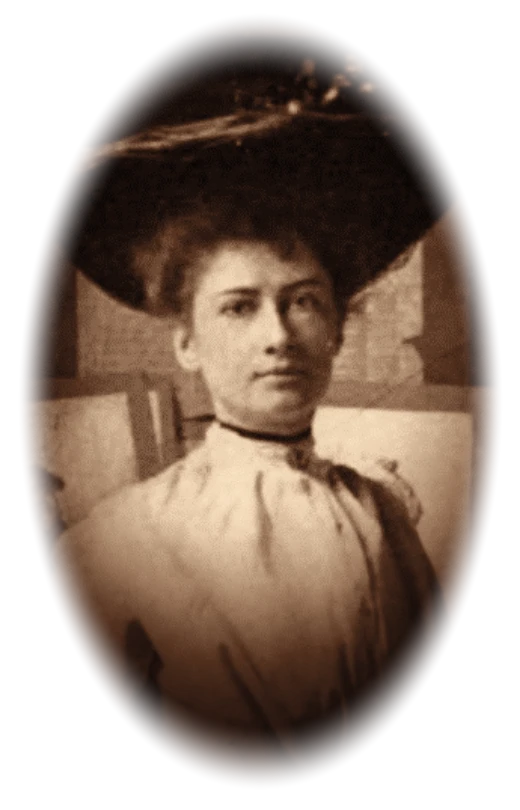
- Photograph: Shinn in her studio, from The Lamp, 1903 or earlier, Wikimedia Commons, public domain in the US: https://commons.wikimedia.org/wiki/File:Photo_Florence_Scovel_Shinn.jpg
