Theron Q. Dumont · London and Chicago, 1916
The Power of Concentration, explained
The Power of Concentration is a 1916 book by Theron Q. Dumont, a pen name of William Walker Atkinson, that teaches focus in twenty lessons and more than twenty exercises, from sitting perfectly still to following the second hand of a clock. The text is public domain. Get the complete book free below as a designed 139-page PDF, try one of its exercises on this page, and read a plain summary of every lesson.
Press and hold the dark field to focus the scattered rays. Lesson XIV, the sun glass.
Book 03
The whole book, set to be practiced
The complete text with its introduction and all twenty lessons, laid out fresh: an opener for every lesson with its 1916 summary, every exercise numbered, the habit maxims and “hold the thought” lines set in copper frames, and a short introduction on who Theron Q. Dumont really was.
- Pages139, at 6 × 9 inches
- Inside20 lessons, clickable contents, bookmarks
- TextComplete, public domain
- FilePDF, 1.8 MB
The download starts right away, and we email you the link so you have it later. Getting the book adds you to our email list. Unsubscribe anytime. Privacy policy.
Try it now
Follow the second hand
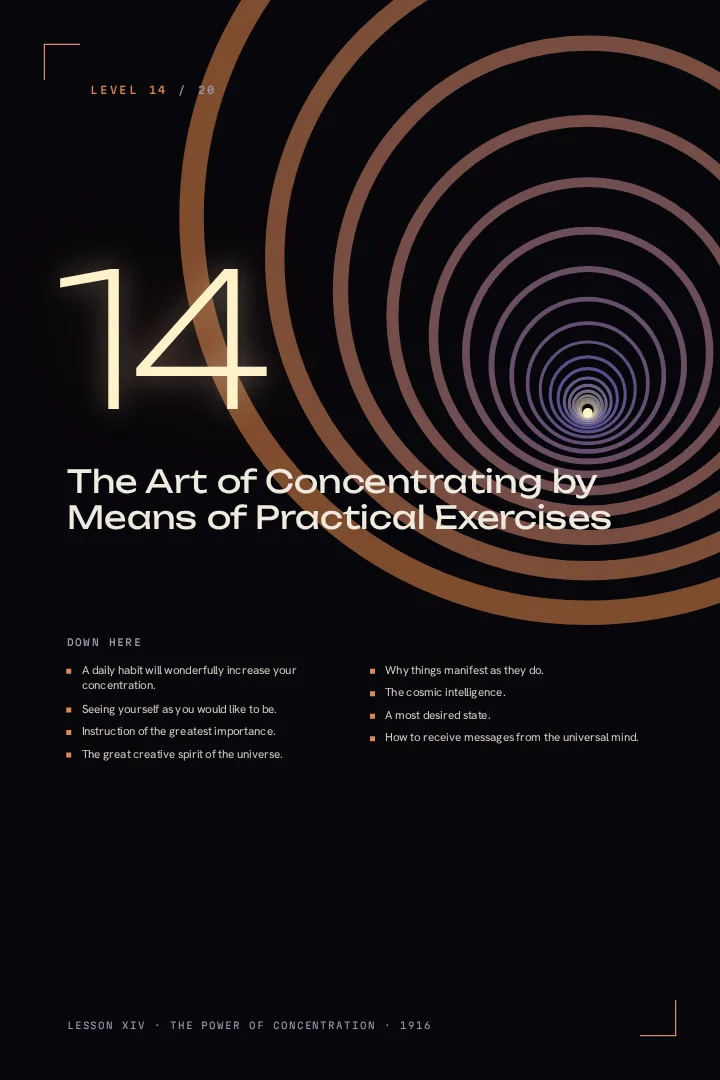
Lesson XIV gives nineteen exercises, and most need nothing but a chair. Exercise 18 needs a clock with a second hand, so here is one. Pick an exercise, press start and do what Dumont says. The rest of the page goes dark until you stop.
Press Esc or Stop to end early. A soft tone sounds when the time is up, so you can look away from the screen.
Lesson by lesson
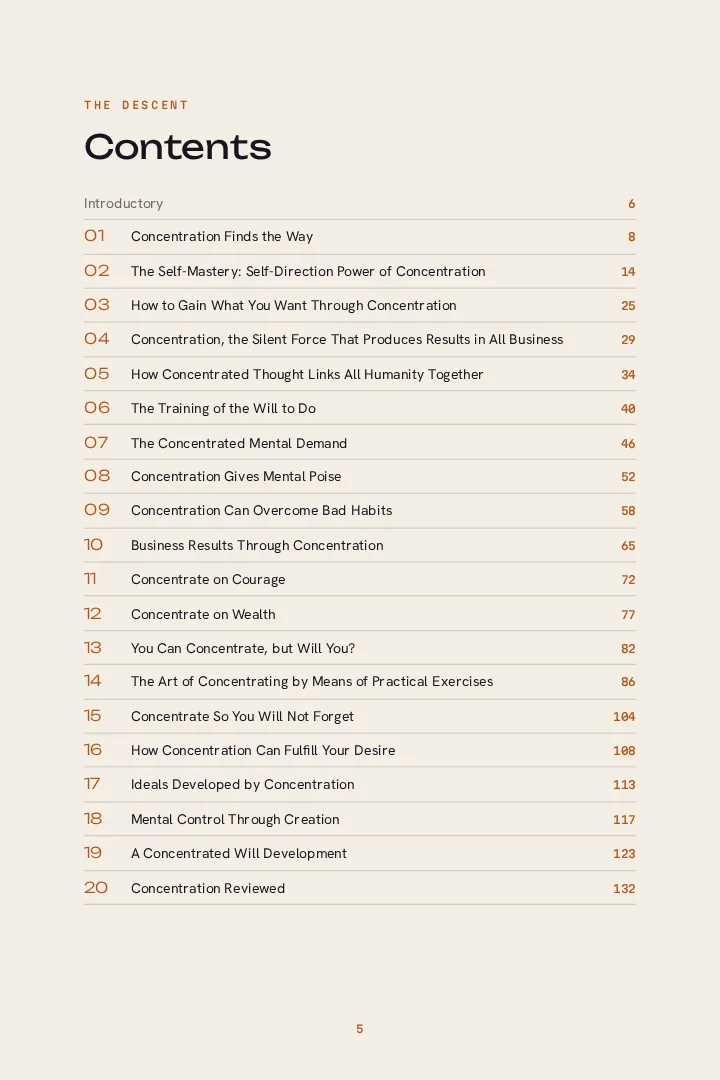
All 20 lessons, one line each
Tap a lesson for the 1916 publisher’s summary. Page numbers are from our PDF.
1890, then 1916
His rules on habit are William James’s
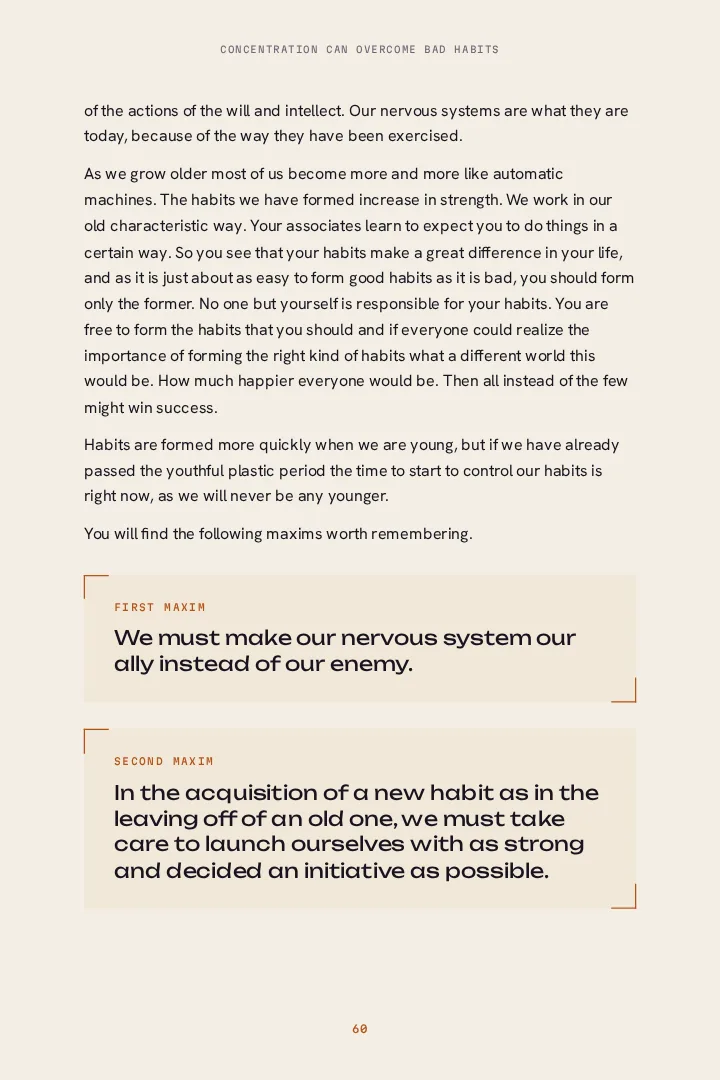
Lesson IX gives five maxims for changing a habit and calls them worth remembering. It does not say where they come from. All five are from the chapter on habit in The Principles of Psychology, published in 1890 by the Harvard psychologist William James. Set them side by side and the borrowing is plain.
- William James, 1890
The great thing, then, in all education, is to make our nervous system our ally instead of our enemy.
Maxim 1Dumont, 1916We must make our nervous system our ally instead of our enemy.
- William James, 1890
In the acquisition of a new habit, or the leaving off of an old one, we must take care to launch ourselves with as strong and decided an initiative as possible.
Maxim 2Dumont, 1916In the acquisition of a new habit as in the leaving off of an old one, we must take care to launch ourselves with as strong and decided an initiative as possible.
- William James, 1890
Never suffer an exception to occur till the new habit is securely rooted in your life.
Maxim 3Dumont, 1916Never allow an exception to occur till the new habit is securely rooted in your life.
- William James, 1890
Seize the very first possible opportunity to act on every resolution you make, and on every emotional prompting you may experience in the direction of the habits you aspire to gain.
Maxim 4Dumont, 1916Seize the very first possible opportunity to act on every resolution you make, and on every emotional prompting you may experience in the direction of the habits you aspire to gain.
- William James, 1890
Keep the faculty of effort alive in you by a little gratuitous exercise every day.
Maxim 5Dumont, 1916Keep the faculty of effort alive in you by a little gratuitous exercise every day.
Before you read
Three things the book won’t tell you
01
Dumont was Atkinson
The title pages make Theron Q. Dumont an instructor in personal magnetism from Paris, France. The publisher was in Chicago, and so was the author: William Walker Atkinson, who also wrote Thought Vibration under his own name and, almost certainly, The Kybalion.
02
1916, not 1918
The first edition came out in London in 1916 from L. N. Fowler. Many copies online, including the scan on archive.org, carry a 1918 date, and some catalogs give that year instead.
03
It promises more than focus
Beside the exercises, the book says concentration lets you influence other people, attract money and receive messages from a “universal mind.” Those parts are New Thought belief of its day. The exercises stand on their own without them.
Real vs legend
What holds up today
| The book says | Status |
|---|---|
| Few people can hold their attention on one thing for long. | Real · minds wander about half the time |
| Do one thing at a time instead of scattering your effort. | Real · switching tasks costs time |
| Habits are built by repetition. | Real · a median of 66 days in one study |
| Never allow one exception until a new habit is rooted. | Mixed · one missed day did not derail it |
| Concentrated thought draws money and success to you. | Legend · no evidence |
| In deep concentration the mind receives messages from a universal mind. | Legend · no evidence |
Mind wandering: Killingsworth and Gilbert, 2010, 46.9 percent of waking hours. Task switching: Monsell, 2003. Habits: Lally and colleagues, 2010, a range of 18 to 254 days.
Questions
The Power of Concentration
Is The Power of Concentration free to download?
Yes. It was first published in 1916, so the text is public domain in the US and free to read, copy and share. Our designed PDF edition of the complete book is free on this page.
Who wrote The Power of Concentration?
It is signed Theron Q. Dumont, billed on his title pages as an instructor in personal magnetism from Paris, France. Theron Q. Dumont was a pen name of William Walker Atkinson (1862 to 1932), a Chicago New Thought writer. Wikipedia and Wikisource both list the book among his works.
What exercises are in The Power of Concentration?
Lesson XIV has nineteen numbered exercises. Among them: sit perfectly still for five to fifteen minutes, hold a full glass of water at arm’s length without a tremor, follow the second hand of a clock for five minutes, and a breathing drill he calls the Eastern way. Lesson XIX adds a six-day drill: look at a door-knob for ten minutes a day and write down what you notice.
How long is The Power of Concentration?
An introduction and 20 lessons, about 38,000 words. That is roughly two and three quarter hours of reading. Our PDF edition runs to 139 pages.
When was The Power of Concentration published?
1916, by L. N. Fowler in London. Many copies, including the scan on archive.org, carry a 1918 date, and some catalogs list that year instead.
Do the concentration exercises work?
The core idea holds up: minds wander about half the time, and switching between tasks costs time and accuracy, so practice at holding attention on one thing is sensible. The book’s larger claims, that concentration attracts money or lets you control other people, have no evidence behind them.
Sources
Where this comes from
- Theron Q. Dumont, The Power of Concentration, L. N. Fowler, London, 1916: The Online Books Page. Text: Project Gutenberg. Scan of a 1918 printing: archive.org.
- William James, The Principles of Psychology, 1890, chapter IV, “Habit”: psychclassics.yorku.ca.
- Matthew A. Killingsworth and Daniel T. Gilbert, “A Wandering Mind Is an Unhappy Mind,” Science 330 (2010): doi.org.
- Phillippa Lally and colleagues, “How are habits formed: Modelling habit formation in the real world,” European Journal of Social Psychology 40 (2010): doi.org.
- Stephen Monsell, “Task switching,” Trends in Cognitive Sciences 7 (2003): doi.org.
- William Walker Atkinson: Wikipedia, Wikisource.