William Walker Atkinson · 1906
Thought Vibration, explained
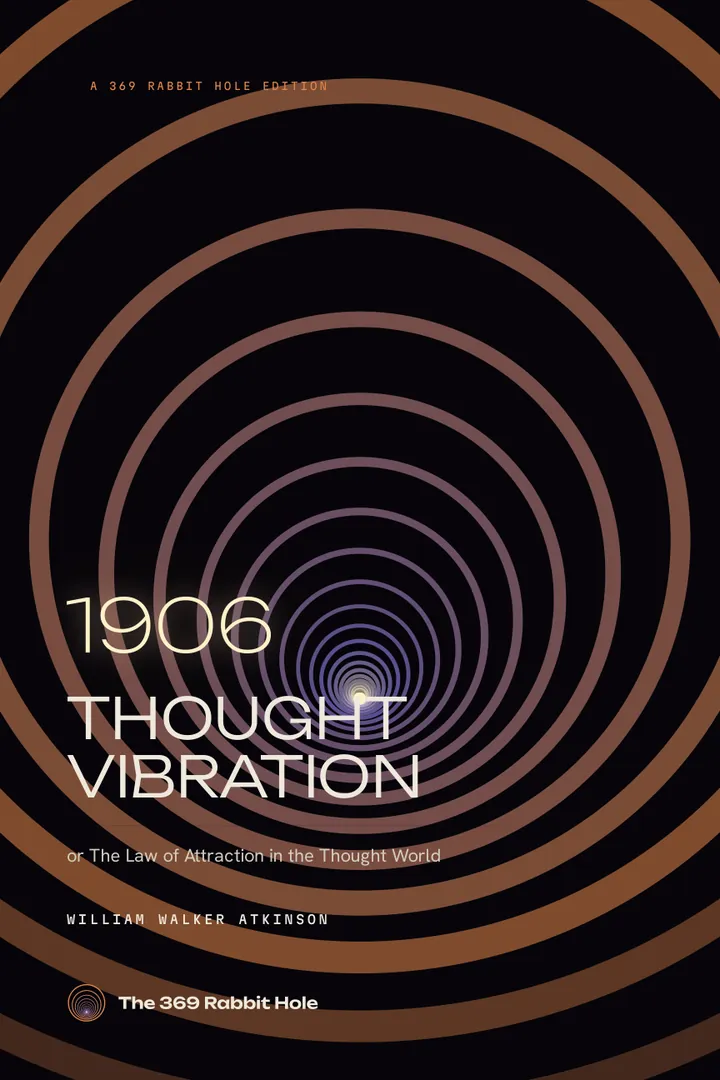
Thought Vibration, or the Law of Attraction in the Thought World is a 1906 book by William Walker Atkinson that teaches that thoughts are vibrations which draw matching people, moods and events to you. Its working method is plainer than its physics: drop fear and worry, retrain your habits, hold one strong desire and use your will. The chapters began as lessons in the Chicago magazine New Thought.
Tap the dark field to drop a thought and watch it spread. Atkinson’s own picture, from chapter II.
Book 01
The whole book, set to be read
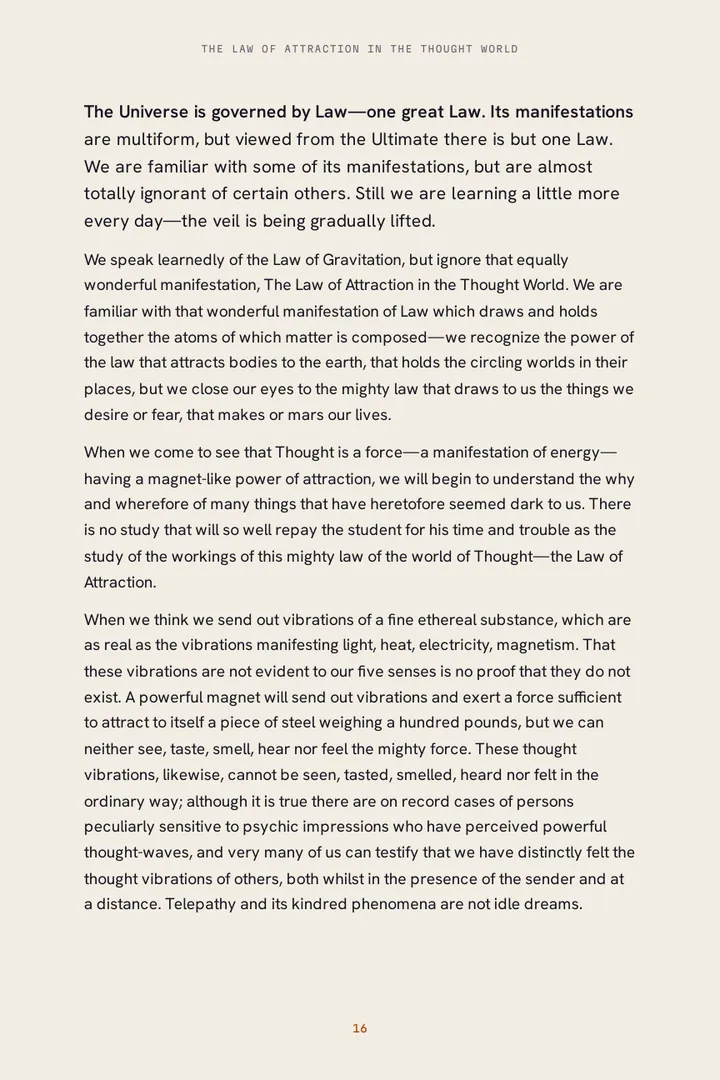
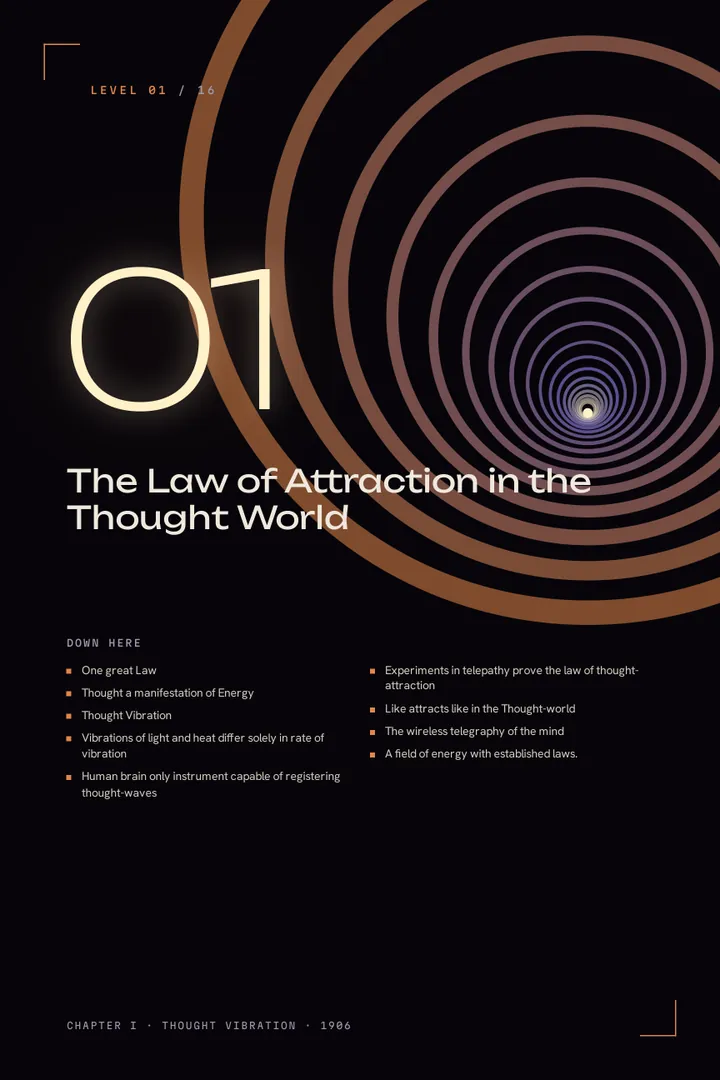
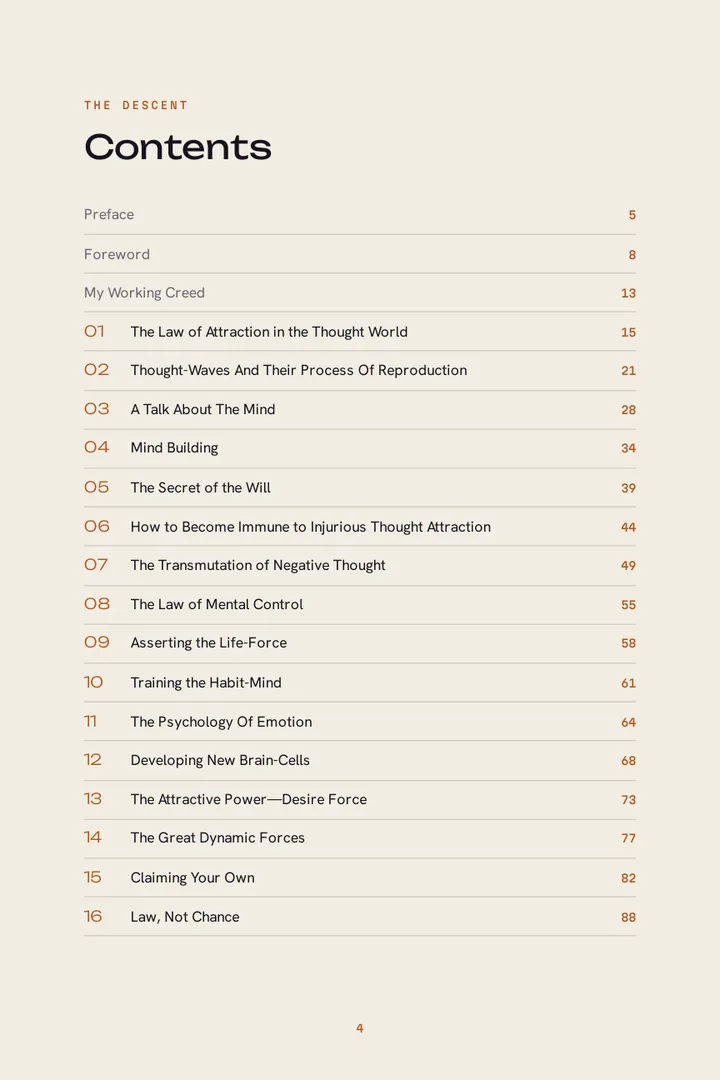
The complete 1906 text with its preface, foreword and creed, laid out fresh: a chapter opener for every lesson, the original chapter summaries, and a short introduction on where the book came from.
- Pages92, at 6 × 9 inches
- Inside16 chapters, clickable contents, bookmarks
- TextThe 1906 edition, unabridged
- FilePDF, 1.4 MB
The download starts right away, and we email you the link so you have it later. Getting the book adds you to our email list. Unsubscribe anytime. Privacy policy.
The book in seven ideas
What Atkinson actually says
- 01
One law runs everything, thought included
He treats thought as a form of energy, the same stuff as light and heat, only vibrating faster. That single claim is the base of the whole book.
“Light and heat are manifested by vibrations of a far lower intensity than those of Thought, but the difference is solely in the rate of vibration.”Chapter I
- 02
Thoughts spread like ripples
Every thought goes out in waves, and you pick up the ones that match your own “pitch.” Live on the fearful note and you tune in fear. He borrows the picture from Marconi’s new wireless.
“Like a stone thrown into the water, thought produces ripples and waves which spread out over the great ocean of thought.”Chapter II
- 03
Like attracts like
What you hold in mind draws matching people, chances and moods to you, the things you fear as surely as the things you want. This is the line the book is remembered for.
“Like attracts like in the Thought World—as ye sow so shall ye reap.”Chapter I
- 04
Cut out fear first
Before anything else, drop fear and worry. Do not fight a negative thought head on. Dwell on its positive opposite until the old one starves.
“Worry is the child of Fear—if you kill out Fear, Worry will die for want of nourishment.”Chapter VII
- 05
Habits are creases you can refold
He quotes the psychologist William James and gives habit its most practical chapter: make the new action often, and never allow the old one “just once.”
“The mind has been likened to a piece of paper that has been folded. Ever afterwards it has a tendency to fold in the same crease—unless we make a new crease or fold, when it will follow the last lines.”Chapter X
- 06
Keep one ruling passion
A mind with a dozen interests leaks its force. Pick the one thing you want most and keep it at the front of your mind every day.
“Keep your eye on the main chance, and keep your one ruling passion strong and vigorous.”Chapter XIII
- 07
Nothing is too good for you
Calling yourself unworthy is a habit of thought like any other. He tells readers to stop shrinking and ask for what they want, plainly.
“There is nothing that is too good for you—not a thing.”Chapter XV
Chapter by chapter
All 16 lessons, one line each
Tap a chapter for the summary the 1906 publisher printed with it. Page numbers are from our PDF.
1906, then 1908
The same ideas, two years later
In 1908 a book called The Kybalion appeared in Chicago, signed only “Three Initiates,” and presented its principles as the ancient wisdom of Egypt. Atkinson almost certainly wrote it. Set his signed book of 1906 beside it and the overlap is plain.
- Atkinson, signed, 1906
The difference is solely in the rate of vibration.
VibrationThe Kybalion, 1908Nothing rests; everything moves; everything vibrates.
- Atkinson, signed, 1906
The mind has many degrees of pitch, ranging from the highest positive note to the lowest negative note.
PolarityThe Kybalion, 1908Opposites are identical in nature, but different in degree.
- Atkinson, signed, 1906
Transmute Worry into keen Desire.
TransmutationThe Kybalion, 1908To change your mood or mental state—change your vibration.
- Atkinson, signed, 1906
There is no such thing as chance.
CausationThe Kybalion, 1908Chance is but a name for Law not recognized.
Real vs legend
What holds up today
| Claim | Status |
|---|---|
| Thought Vibration was published in Chicago in 1906. | Real · preface dated June 15, 1906 |
| Its chapters were first lessons in New Thought magazine. | Real · the 1906 preface says so |
| Atkinson coined the phrase “law of attraction.” | No · in use decades earlier |
| Repeating an action makes it automatic. | Real · habit studies, median 66 days |
| Expecting to fail makes failing more likely. | Partly · expectations change effort |
| Thoughts travel out as waves, like light. | No evidence · no such wave found |
| Telepathy experiments prove the law. | No · never reliably shown |
The parts about habit, attention and fear have support in modern research. The physics does not. For what the studies say about wishing, picturing and planning, read is the law of attraction real?
Questions
Thought Vibration
What is Thought Vibration about?
It teaches that thoughts are vibrations that draw matching people, moods and events to you, so the work is to drop fear and worry, retrain your habits, hold one strong desire and use your will. It is 16 short lessons written in plain, direct talk.
Who wrote Thought Vibration?
William Walker Atkinson (1862 to 1932), a Chicago New Thought writer and editor. The preface is by Franklin L. Berry, editor of the magazine New Thought, and it credits Louise Radford Wells with choosing the title and chapter headings and arranging the lessons.
When was Thought Vibration published?
In 1906, by The New Thought Publishing Co. of Chicago. Its preface is dated June 15, 1906. The chapters began as lessons Atkinson wrote for New Thought magazine after he became its editor in December 1901.
Is Thought Vibration the same book as The Law of Attraction in the Thought World?
Yes. The full title is Thought Vibration, or the Law of Attraction in the Thought World, and many modern reprints sell it under the subtitle alone.
Is Thought Vibration in the public domain?
Yes. It was published in the United States in 1906, so it is public domain in the US. Atkinson died in 1932, so it is also public domain in countries that use life plus 70 years. You can read, share and print it freely.
How long does Thought Vibration take to read?
About 25,000 words, so roughly an hour and 50 minutes at an average reading pace. The chapters are short lessons, and most take under ten minutes.
Did Thought Vibration invent the law of attraction?
No. The phrase was in use decades earlier. Thought Vibration is one of the first books to turn it into a full working method, a century before The Secret made it famous.
Sources
Where this comes from
- William Walker Atkinson, Thought Vibration or the Law of Attraction in the Thought World, The New Thought Publishing Co., Chicago, 1906, with the preface by Franklin L. Berry: archive.org.
- Three Initiates, The Kybalion, Yogi Publication Society, Chicago, 1908. Text of the 1912 printing: Project Gutenberg.
- Phillippa Lally and others, “How are habits formed: Modelling habit formation in the real world,” European Journal of Social Psychology 40 (2010): doi.org.
- William Walker Atkinson: Wikipedia.
More on the author, his pen names and his other books: William Walker Atkinson.