The man who answered in his sleep
Who was Edgar Cayce?
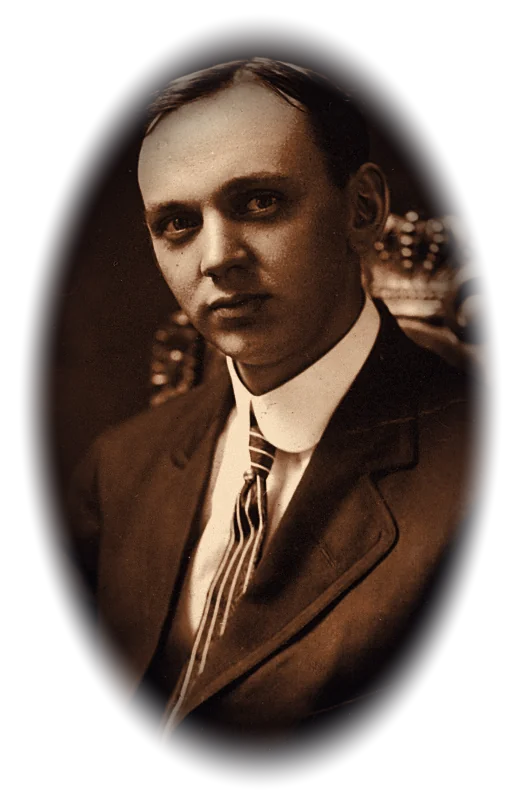
Edgar Cayce (1877 to 1945) was a Kentucky photographer and Sunday school teacher who would lie down, close his eyes and answer questions from what looked like sleep. More than 14,000 of those sessions were written down, and the transcripts, which he called readings, are why people still know his name. Most of them diagnose sick people he never met. From late 1923 they also range over past lives, Atlantis and the soul, which is how a man who left school in the ninth grade came to be called the sleeping prophet.
We counted every reading ourselves. Reading numbers are given so you can check us.
Contents
Every page in this section
What the readings said
- 01His predictions, scoredEvery dated forecast, the reading it came from and what happened.
- 02The akashic recordsWhere the word came from and when it entered his readings.
- 03Vibration, color, numbers and soundEverything he tied to vibration, counted.
- 04Atlantis and the Hall of RecordsThe places he named, on a map, and Bimini Road.
His life
Tools
Every reading, year by year
Four decades in one chart
We sorted the 14,097 readings that carry a date by the year he gave them. The tall copper bars count every session, and the violet inside them are life readings, the ones about past lives. Before 1922 most sessions went unrecorded. In October 1922 he told a Birmingham paper he had diagnosed 8,056 cases so far, yet fewer than 500 from before 1923 survive. Tap a year to see where he was and what was happening.
1943
| Year | Readings | Life readings |
|---|---|---|
| 1902 | 1 | 0 |
| 1903 | 1 | 0 |
| 1907 | 1 | 0 |
| 1909 | 3 | 0 |
| 1910 | 41 | 0 |
| 1911 | 97 | 0 |
| 1912 | 3 | 0 |
| 1917 | 15 | 0 |
| 1918 | 2 | 0 |
| 1919 | 1 | 0 |
| 1920 | 17 | 0 |
| 1921 | 58 | 0 |
| 1922 | 240 | 0 |
| 1923 | 348 | 11 |
| 1924 | 482 | 28 |
| 1925 | 634 | 63 |
| 1926 | 688 | 52 |
| 1927 | 491 | 40 |
| 1928 | 438 | 23 |
| 1929 | 573 | 37 |
| 1930 | 742 | 62 |
| 1931 | 509 | 83 |
| 1932 | 437 | 45 |
| 1933 | 475 | 61 |
| 1934 | 702 | 97 |
| 1935 | 733 | 107 |
| 1936 | 653 | 113 |
| 1937 | 622 | 96 |
| 1938 | 664 | 105 |
| 1939 | 685 | 130 |
| 1940 | 568 | 125 |
| 1941 | 606 | 110 |
| 1942 | 557 | 94 |
| 1943 | 1008 | 201 |
| 1944 | 1002 | 222 |
Kinds are our own sort, made from the request his conductor read out before each session. Life readings are the clearest to spot, so we show those. A few dates in the record are plainly wrong. One reading is dated 1947, two years after he died, and we left it out.
How a reading went
The same few lines, thousands of times
The transcripts follow a set pattern, and you can count it. Here it is, with the number of transcripts in which each step is written down.
- He lay down. Dr. Wesley Ketchum, who worked with him from 1910 to 1912, put it this way in 1910: the subject “simply lies down and folds his arms, and by auto-suggestion goes to sleep.”
- Someone read him the request. The header names this person as conductor. His wife Gertrude held the job in 11,882 readings, their son Hugh Lynn in 641, his father in 223.
- He found the person. A health reading usually opens with some form of “we have the body,” written in 8,435 of them, whether the patient was in the room or a thousand miles away.
- A stenographer took it down. Gladys Davis joined in September 1923 and is named in 12,666 headers. Most of the text that survives is her shorthand, typed up.
- Then came questions. 9,366 readings hold the line “Ready for questions,” where the sitter’s own list begins.
- He signed off. 12,736 readings close on the words “We are through.”
Where he gave them
Nine places, one beach house
The header of each reading says where he lay down. Over eleven thousand were given at Virginia Beach, most of them on Arctic Crescent, in the family home or the Association’s office on the same street. Before the move in 1925 he worked from Hopkinsville, Selma, Birmingham, and hotel rooms and an office in Dayton, Ohio.
| Place | Readings | Years |
|---|---|---|
| Virginia Beach | 11,190 | 1925 to 1944 |
| Dayton | 969 | 1923 to 1925 |
| New York | 424 | 1921 to 1941 |
| Birmingham | 219 | 1920 to 1928 |
| Hopkinsville | 144 | 1909 to 1935 |
| Washington | 139 | 1933 to 1935 |
| Selma | 95 | 1917 to 1928 |
| Norfolk | 77 | 1925 to 1938 |
| Chicago | 45 | 1923 to 1928 |
Free to take with you
Two PDFs and a finder
- Free PDFEdgar Cayce in the newspapersEvery article we found from his lifetime that is now in the public domain, transcribed in full, in date order.
- Free PDFThe Readings IndexThe topics people ask about most, what he said on each in plain words, and the reading numbers to look up.
- ToolReading FinderFind any reading by date, place, kind or topic, or the one given on your birthday.
Why we quote so little
The readings are still owned
Unlike the Neville and Atkinson books on this site, the readings are not public domain. The Edgar Cayce Foundation in Virginia Beach registered them for copyright in 1971 and lets anyone quote up to 500 words in a published work without asking. We treat this whole section as one work and stay under that line, so you will mostly find counts, dates and reading numbers here, with short quotes only where his exact words matter.
Every reading is numbered in two parts. In 254-114 the first number stands for a person or group and the second says which of their sessions it was. Members of the Association for Research and Enlightenment, which he founded in 1931 and which still runs in Virginia Beach, can read all of them online.
Questions
What people ask about him
Who was Edgar Cayce?
An American from Christian County, Kentucky, who lived from 1877 to 1945 and gave readings from a trance-like sleep for more than forty years. He worked as a photographer, taught Sunday school, and from 1925 lived in Virginia Beach, where he founded the Association for Research and Enlightenment in 1931. More than 14,000 of his readings were written down.
Why was Edgar Cayce called the sleeping prophet?
Because the readings came while he appeared to be asleep, and because some of them looked ahead. The name stuck after Jess Stearn's 1967 bestseller The Sleeping Prophet. Forecasts are a small part of the record, though. By our sort more than 9,000 readings deal with someone's health.
How many readings did Edgar Cayce give?
The A.R.E. counts 14,306 recorded readings, and we found 14,301 in the full text we counted. He gave many more that nobody wrote down. In October 1922 a Birmingham paper quoted him as having diagnosed 8,056 cases so far, yet fewer than 500 recorded readings survive from before 1923.
Was Edgar Cayce illiterate?
No. He had an eighth-grade education and left school in the ninth grade when his family could not pay for more. The 1910 New York Times headline called him an illiterate man who became a doctor when hypnotized, which made a better story than the facts did.
What did Edgar Cayce say about Jesus?
The readings call Jesus the Christ and also treat him as a soul who had lived on earth before. Asked on April 5, 1932 for the important earlier lives of Adam, reading 364-7 gave a list running from Amilius and Adam through Melchizedek and Asaph to Jesus. The name Jesus comes up 792 times across 432 readings, nearly all of them from 1932 on.
Did Edgar Cayce believe in God?
Yes. He was raised in the Disciples of Christ, taught Sunday school and Bible classes, called himself a devout Christian and denied being a spiritualist. He said he read the Bible once every year.
Sources
- Counts: our own, from the full text of 14,301 readings, each sorted by its header date and place. The A.R.E. gives 14,306 as the full number.
- Biography and dates: Edgar Cayce on Wikipedia, checked November 14, 2026.
- Reading count and member access: A.R.E. membership page.
- Quotation rules: Edgar Cayce Foundation, Copyright and Reference Guidelines.
- Photograph: Cayce 1910, Wikimedia Commons, public domain, printed on the front page of The New York Times in October 1910.
- Ketchum’s description of the trance, 1910, as quoted on Wikipedia.
- Edgar Cayce Readings © 1971, 1993-2007 by the Edgar Cayce Foundation. All Rights Reserved.
