← Neville Goddard Who was Abdullah?

The evidence file

Who was Abdullah, Neville Goddard’s teacher?

  • 67 passages
  • 19 talks and books
  • Three theories tested

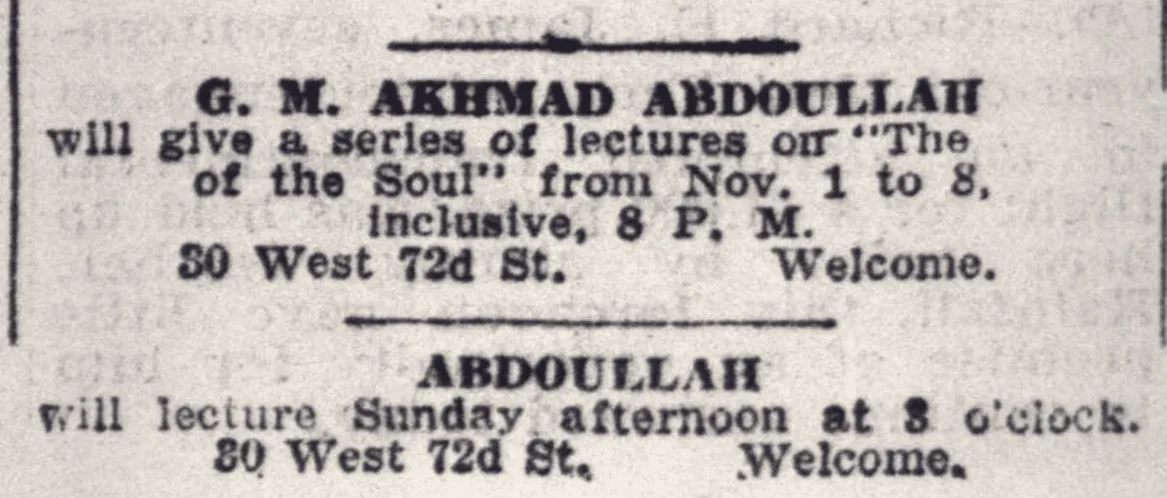
Abdullah was the Black teacher Neville Goddard credited with first showing him the power of imagination, and nearly everything we know about him comes from Neville’s own talks. Those talks disagree on the year they met and on where Abdullah was born. The best lead we found is a man the New York Times lists lecturing at 30 West 72nd Street in November 1928, G. M. Ahmad Abdoullah, at the exact address Neville gave in 1971. We read that ad on the scan. The match is strong, though no document yet puts the two men in one room.

Two small 1928 newspaper notices: G. M. Akhmad Abdoullah will give a series of lectures, and Abdoullah will lecture Sunday afternoon, both at 30 West 72d St.
Exhibit A. The New York Times, November 3, 1928, church notices. The same address Neville named 43 years later.

The file

Every passage we found, sorted

We searched the 320 texts in our index and the rough merged archive for his name, for “Ab,” and for phrases that only fit him, then read every hit. Each card below gives the talk and the date, with a link for reading around the line. Titles and dates are the transcripts’ own, and a transcript typed from tape can mishear a word.

What Neville said67 of 67

Each tick is one passage, placed by year. Tap one to see the talk. He says almost nothing about Abdullah between 1954 and 1964.

First meeting 12

  1. “When he met me he told me that I had come to do a certain work, and he called me by name, though I had never before met him or he me.”

    The Birth of the Babe

  2. “He said to me in 1933 (I met him in ’29)”

    Spoken as an aside. It is the only place he gives 1929.

    One Greater Than John

  3. “Ab was just about to start when I went through the door”

    A Sunday evening. He says twenty people were present.

    Who Are the Condemned?

  4. “You are late, Neville, six months late.”

    Who Are the Condemned?

  5. “He went to Fordham University in the hopes of becoming a priest and he flunked in his third year.”

    The friend who brought him, named here as David.

    Who Are the Condemned?

  6. “Well, I’ll tell you in details exactly how we got together.”

    He then begins in 1933 with the Barbados request and never reaches the first meeting.

    Abdullah, How We Got Together (Q&A)

  7. “When I first met my friend Abdullah back in 1931 I entered a room where he was speaking and when the speech was ended he came over”

    A Lesson in Scripture

  8. “The brothers told me that you were coming and you are six months late.”

    A Lesson in Scripture

  9. “I was late because the one who told me of Abdullah was a Catholic priest.”

    In the March 1964 telling this same man flunked out at Fordham.

    A Lesson in Scripture

  10. “We were together in China thousands of years ago, but you promised to completely forget in order to play the part you must play now.”

    A Lesson in Scripture

  11. “At the end of the meeting, Ab approached me”

    Power and Wisdom

  12. “I will remain until you have received all that I must give you. Then I will depart.”

    Power and Wisdom

His age 5

  1. “An old, old man, he was then in his late eighties when I met him.”

    One Greater Than John

  2. “from the time of birth up until he was almost eighty years old, he hadn’t touched pork”

    Then, he says, the old man had the same break he had.

    One Greater Than John

  3. “Ab was an old man when I met him, he was then about ninety.”

    Who Are the Condemned?

  4. “I picked up this garment ninety-odd years ago in Ethiopia.”

    Quoted as something Abdullah would say. The garment is the body.

    Who Are the Condemned?

  5. “a man not over fifty years old”

    A dream vision on the morning of the talk. He gives his own height as 5 foot 11, says Ab was the same, and sees him here at about 6 foot 5 in a white body.

    Who Are the Condemned?

Origin 9

  1. “He was as black as the ace of spades, my old friend Abdullah, with his turbaned head.”

    The only turban anywhere in the 1.57 million words.

    1948 Lesson 3

  2. “He would never allow anyone to refer to him as a colored man.”

    Changing the Feeling of “I”

  3. “I am very proud that I am a negro.”

    As he remembers it, on the head of the Sphinx.

    Changing the Feeling of “I”

  4. “He was born and raised in the Jewish faith”

    One Greater Than John

  5. “He was born in Ethiopia of the Negro race in the Hebraic faith.”

    Who Are the Condemned?

  6. “he was born in North Africa, of Jewish parents, and raised in a strict Orthodox Jewish home.”

    How We Got Together (Q&A)

  7. “He spoke other tongues. And Rabbis would come to study with him.”

    How We Got Together (Q&A)

  8. “He was born, so I am told, in Ethiopia.”

    Late in life he adds the hedge.

    Gifts Bestowed by God

  9. “He was a black man, raised in the Jewish faith”

    Gifts Bestowed by God

What he taught 15

  1. “my old friend Abdullah, with whom I studied Hebrew for five years”

    1948 Lesson 3

  2. “If I were called upon to name a man that I would consider my teacher, I would name Abdullah.”

    Changing the Feeling of “I”

  3. “Neville, you must first start with self.”

    Changing the Feeling of “I”

  4. “I was first made conscious of the power, nature, and redemptive function of imagination through the teachings of my friend Abdullah”

    Awakened Imagination

  5. “The King of Kings, the Eternally-Becoming One, which men call Christ, must ever be remembered as a little child.”

    He says Ab wrote this on a piece of paper in 1933 and that he kept it in an old Bible.

    The Birth of the Babe

  6. “If my old teacher, Ab, were here, he would frighten you to death.”

    Esau and Jacob

  7. “The Brothers told me that you would die and not really die.”

    The prediction he says came true on the ship home.

    One Greater Than John

  8. “I studied with Abdullah for seven years in New York City, seven days a week.”

    Who Are the Condemned?

  9. “always referred to the divine society as the brothers.”

    Who Are the Condemned?

  10. “for over five years, teaching me all that he could teach me that I could absorb concerning the Kabbalah”

    How We Got Together (Q&A)

  11. “If you did it, then you’re pregnant. Let the child grow.”

    His teacher’s way of saying an assumption needs no further discussion.

    How We Got Together (Q&A)

  12. “in trying to show me how to pronounce it he would have to belch.”

    On the divine name, Yod He Vau He.

    The Real Man

  13. “You will die, but you will not surely die.”

    No Other Foundation

  14. “Praise be to that unity which is our unity.”

    How he says Ab opened every class.

    I Am the Lord

  15. “He understood the Law, not the Promise.”

    The visions he called the Promise began in 1959.

    Gifts Bestowed by God

His habits 12

  1. “I have said all that I have to say.”

    Said from the doorway before he closed it on Neville.

    1948 Lesson 3

  2. “I have seen scientists, doctors, lawyers, bankers, from every walk of life seek an audience with old Abdullah”

    Changing the Feeling of “I”

  3. “And if you knew Abdullah as I knew him that was no invitation to come in.”

    One Greater Than John

  4. “But he would never take a dollar from me.”

    Who Are the Condemned?

  5. “he rented the first floor to my friend Abdullah.”

    The house, he says, was the Morgenthau family’s.

    How We Got Together (Q&A)

  6. “a huge big bowl of ice cream.”

    After rye, ale and a large dinner.

    How We Got Together (Q&A)

  7. “you couldn’t do it... it would poison you, because you have quibbles.”

    His answer when vegetarian Neville asked how he could eat like that.

    How We Got Together (Q&A)

  8. “Say... how long do you expect those things to last?”

    A week after Neville brought him brandy and rum from Barbados.

    How We Got Together (Q&A)

  9. “I want two in the center. I don’t want too far back.”

    Buying orchestra seats at the box office in person, where he says a Black New Yorker was sent to the balcony.

    How We Got Together (Q&A)

  10. “The first opera I saw, Abdullah took me to it. It was Parsifal.”

    Five hours, on a Good Friday.

    How We Got Together (Q&A)

  11. “Ab once told me that I was so good, I was good for nothing.”

    The Spirit Within

  12. “He lived at 30 West 72nd Street.”

    The one exact address he ever gave.

    Gifts Bestowed by God

The drills 7

  1. “and fall asleep viewing the world from Barbados.”

    Awakened Imagination

  2. “You just simply sleep this night in Barbados.”

    How We Got Together (Q&A)

  3. “My old friend, Abdullah, gave me this exercise.”

    The chair by the phone.

    The Secret of Prayer

  4. “When I was with my old friend Abdullah...I would have an exercise.”

    The fuller transcript of the same night.

    The Secret of Praying

  5. “At dinner he would ask me to look at the lampshade.”

    Follow the Pattern

  6. “not with my outer eyes but with my inner eye; and when I did, I would always see Man.”

    Follow the Pattern

  7. “You must actually live in Barbados in your imagination as though you were there”

    Gifts Bestowed by God

His death 7

  1. “that wonderful poem of the death of Abdula”

    A false lead. This is Edwin Arnold’s poem After Death in Arabia, and its Abdallah is a character in it.

    Good Friday, Easter

  2. “Ab is gone from this world now.”

    Who Are the Condemned?

  3. “The last time I met Abdullah was about eight years ago in New York City.”

    March 1964 minus eight years gives about 1956.

    Who Are the Condemned?

  4. “About seven years ago I met his secretary and she voiced that request of his”

    The request was to take his body back to Ethiopia.

    Who Are the Condemned?

  5. “I haven’t seen or heard from Abdullah or the secretary since.”

    Who Are the Condemned?

  6. “Lived to be over a hundred and had one consuming desire, to put the body back where he picked it up which was in Ethiopia.”

    Who Are the Condemned?

  7. “He, too, may have longed to go, but he had to wait for me.”

    Power and Wisdom

Side by side

Where his accounts disagree

He told these stories for 23 years from memory, on a stage, so some drift is normal. A few of the differences matter for identifying the man, and those are the first six rows. The door is here because it is the same scene told four ways.

DetailOne versionAnotherA third
Year they met’29 One Greater Than John, Jan 19641931 A Lesson in Scripture, Oct 19671933, when asked how they got together Q&A, 1964
Years togetherFive 1948 Lesson 3; Changing the Feeling of “I,” 1953Over five Q&A, 1964Seven, every day Who Are the Condemned? Mar 1964
BirthplaceEthiopia Mar 1964North Africa Q&A, 1964Ethiopia, “so I am told” Gifts Bestowed by God, 1971
Age at meetingLate eighties Jan 1964About ninety Mar 1964
Who brought himA Catholic priest Oct 1967David, who flunked out of Fordham before ordination Mar 1964A man he did not trust Power and Wisdom, Oct 1968
Whose house“owned by Morgenthau” Q&A, 196430 West 72nd Street Gifts Bestowed by God, 1971Same building. The Times reports Mrs. Morgenthau sold it to a voice teacher in September 1923 Our check
When Ab spoke to himBefore the talk began Mar 1964“when the speech was ended” Oct 1967“At the end of the meeting” Oct 1968
The door that slammedHis study 1948 Lesson 3His studio Jan 1964His little library Q&A, 1964. His bedroom 1971

The Morgenthau row is the most useful line on this page. In 1964 he describes a house and in 1971 he gives a number, and the two memories land on one building. The New York Times and the Musical Courier both name 30 West 72nd Street as the Morgenthau residence when it sold in 1923, so the family had left by the time Neville met anyone there, though the name could easily have stayed with the house.

The age problem

Every number he gave points near 1840

Turn each age into a birth year and Neville’s figures cluster around 1840. Take them literally and his teacher was about 116 at their last meeting in 1956. Both historical candidates were born thirty years or more after that, which is the hardest gap in the whole case.

Implied birth yearTap a row

The shaded band marks where Neville’s own ages land.

The numbers as a table
SourceStatedImplied birth

One way to close the gap appears in a 1935 society column that Cool Wisdom Books transcribed from the Madison Eagle. It calls G. Ahmad Abdoullah “past 90 years of age” in the same year he was filing songs at the Copyright Office. The same man, by that site’s reading of the 1920 census, had given his age as 49. If both are one person, the great age was part of the persona, and Neville believed it.

The ledger

Three theories, for and against

Each line is marked by how close we got. Read means we read the original or a scan of it ourselves. Secondhand means we read someone else’s account of it and could not see the original.

Theory one, from Mitch Horowitz

Arnold Josiah Ford

Unproven, and the dates cut against it

A Barbados-born musician and Black Hebrew leader in Harlem, 1877 to 1935, and musical director for Marcus Garvey’s organization.

For

  • Secondhand Born in Barbados like Neville, called an “Ethiopian rabbi,” and photographed “wearing a turban.” Horowitz, reposted at fortvrz.
  • Secondhand Historian Howard Brotz, as Horowitz quotes him: “It is certain that he studied Hebrew with some immigrant teacher.”
  • Secondhand Horowitz also cites Jill Watts on the mind-power strand inside Ethiopianism, which sits close to New Thought.

Against

  • Read He left for Ethiopia in 1930 by Wikipedia’s account, 1931 by Horowitz’s, and died there in September 1935. He says he last met his teacher in New York about 1956.
  • Read Born 1877, so he was 52 in 1929, when Neville’s teacher was in his late eighties.
  • Read Himself from Barbados, he never calls his teacher a fellow islander.
  • Read Horowitz concedes the point himself: “The timing of Ford’s departure is the biggest single blow to the Abdullah-Ford theory.”

Theory two, from Cool Wisdom Books

G. Mahmud Ahmad Abdoullah, also Modeste Abdallah Guillaume

The strongest lead, still unproven

By that site’s account, an Atlantic City baritone and voice teacher who turned to metaphysics around 1920 and moved to West 72nd Street. Its Abdullah series is long, and we went to the originals wherever we could find them.

For

  • Read The New York Times, November 3, 1928: two notices for G. M. Akhmad Abdoullah at 30 West 72d St. The digits print heavily in the scan, and they match the 3 in “at 3 o’clock” beside them.
  • Read The Times, December 18, 1928: G. M. Ahmad-Abdoullah, “religious teacher,” speaks for Islam at a Fellowship of Faiths meeting at St. Bartholomew Community House, with Swami Yogananda on the same program. His line that night: “Religion, the one true religion, is love.”
  • Read Catalog of Copyright Entries, 1923: a book by G. Mahmud-Ahmad Abdoullah, claimed by G. Modeste Abdoullah of Atlantic City. One filing ties the two names together. A companion title is Science of applied mind control and wealth of Abdoullahistic metaphysiology.
  • Read Catalog of Copyright Entries, 1935: nine songs by G. M. Ahmad-Abdoullah of New York, including Ave Maria and Sehnsucht. A composer fits the man Neville watched drinking in every note of Parsifal.
  • Read The Times and the Musical Courier, September 1923: 30 West 72nd Street was the Morgenthau residence, sold to voice teacher W. Henri Zay. That matches both of Neville’s memories.
  • Secondhand The 1920 census at 1708 Arctic Avenue, Atlantic City: G. M. Abdallah, 49, music teacher, born in Algiers, which fits “North Africa.”
  • Secondhand Copyright cards from 1935 giving 30 W. 72nd Street as the songwriter’s address. Cool Wisdom Books ordered the cards. The printed catalog we read says only New York.
  • Secondhand The Madison Eagle, October 4, 1935: “his secretary Miss Zaida Roberts,” and “He teaches singing and conducts classes in philosophy at his home in New York City.” Neville says he met Abdullah’s secretary in the 1950s.
  • Secondhand Rose Mackenberg, Houdini’s investigator, printed a 1929 certificate from his Atlantic City church, the Church of the Religion of Love, made out to her own undercover alias.
  • Secondhand A 1909 studio portrait of Modeste Guillaume in a turban, published by the same site.

Against

  • Read No document we have seen names Neville and this man together.
  • Read In 1928 he is a speaker for Islam, and Neville’s teacher was raised in “a strict Orthodox Jewish home.” His filings do use Hebrew and Kabbalah, by the site’s account, so this may be one more costume, but it is a real mismatch.
  • Secondhand The 1920 census age makes him about 58 in 1929, thirty years younger than Neville remembered.
  • Secondhand The census says Algiers. Neville said Ethiopia more often than he said North Africa, and the site’s reading of “Ethiopia” as a loose word for Africa is an argument.
  • Read Joseph Murphy’s memory, as printed by Bernard Cantin, is of “Professor Abdullah, a black Jew from Israel,” which is a different biography again.
  • Read We found no death record and no sign of the return to Ethiopia.

Theory three, kept open by Horowitz

A composite, or an invention

Possible for some details, unlikely for the whole man

Neville may have blended several teachers into one figure, or shaped a real man to suit a sermon.

For

  • Read The disagreements in his own tellings, set out above.
  • Read Horowitz: “Or Abdullah may have been a metaphorical composite of several contemporaneous figures, perhaps including Ford.”
  • Read Abdullah works as a teaching device. He is rude at exactly the right moment and never explains, and the talks use him the way a parable uses a character.

Against

  • Read Neville gives a street number, and a man of that name was lecturing there.
  • Read Israel Regardie, writing in 1946 with Neville alive, calls him “an eccentric Ethiopian rabbi named Abdullah.” That still rests on Neville’s word.
  • Read Horowitz again, on pure invention: “this scenario doesn’t account for Joseph Murphy’s record.”

His three drills

What Abdullah had him practice

Neville gave these over decades, always briefly. All three train the same thing, moving your point of view while your body stays put. What follows is what he said happened when he did them.

bodyphone

The chair by the phone

“With my eyes closed, I would assume I was in the chair by the phone. Then I would feel myself back in the living room.”

He sat where he could not see the hall and went there and back over and over until he “discovered the feeling of changing motion.” His claim for the payoff is large: the day you imagine a place and are seen there by the people in it. The longer transcript of that night adds that he refused to picture the living-room chair at all while he sat, in his mind, by the phone.

The Secret of Prayer, Oct 6, 1967

eye

Through the lampshade

“Looking beyond, I would see living, breathing human faces.”

This one happened at dinner. Abdullah would name an object, a lampshade or later a car, a house or a wall, and Neville would look past it with what he calls the inner eye. He says it got strong enough that he had to stop: “I could feel myself moving through and beyond this world.”

Follow the Pattern, Mar 25, 1968

New Yorkyou, asleep

Sleep in the place

“You must imagine yourself right into the state of your fulfilled desire,”

Abdullah’s instruction in 1933 was to spend the night in the wish. Neville lay down on 75th Street as if in his mother’s house and placed New York 2,000 miles to the north of the bed. The test of that method is the Barbados story, every version lined up.

Awakened Imagination, 1954

Open items

What we could not verify

  1. Whether G. M. Ahmad Abdoullah taught Neville. The address, the singing, the secretary and the timing all fit, and nothing yet says so outright.
  2. The Mackenberg clipping of February 23, 1929, itself. Wikipedia cites it, and Cool Wisdom Books transcribes the certificate as made out to “Rev. Allicia Bunck of Philadelphia,” an alias Mackenberg used to mean all is bunk. We have not held the page.
  3. The 1920 census line and the 1935 Madison Eagle note. Both reach us through Cool Wisdom Books.
  4. Abdullah’s death. There is no record, no obituary and no ship we can find, and the plan to return to Ethiopia exists only in Neville’s March 1964 answer.
  5. Which year they met. Wikipedia’s range of 1929 to 1936 fits one of Neville’s dates, and we found nothing independent that fixes it.
  6. Two quotes circulating from tapes: an Atlantic City story said to come from the 1968 talk I Am in You, and a line calling Abdullah a Negro Jew from a 1964 talk called For Hatching. Neither is in the transcripts we hold.
  7. One commercial site says Mitch Horowitz helped settle on Guillaume. The Horowitz essay we read argues for Ford, and we found no statement from him on Guillaume.

Questions

Abdullah

Was Abdullah a real person?

Very probably. Neville gave a street number, 30 West 72nd Street, and the New York Times lists a G. M. Ahmad Abdoullah lecturing at that address in November 1928. Joseph Murphy also remembered a Professor Abdullah. No document we have seen links Neville and Abdoullah by name.

Where did Neville say Abdullah was born?

In Ethiopia, in a March 1964 talk and again in June 1971, when he added so I am told. In a 1964 question and answer he said North Africa, of Jewish parents. Those are the only birthplaces he gives anywhere in our archive.

How long did Neville study with Abdullah?

He said five years in 1948 and 1953, over five years in a 1964 question and answer, and seven years, seven days a week, in a March 1964 talk. The years named for their first meeting are 1929 and 1931.

Was Abdullah the same man as Arnold Josiah Ford?

Probably not. Ford sailed to Ethiopia about 1930 and died there in 1935, and Neville said he last met Abdullah in New York in about 1956. Ford was also 52 in 1929, when Neville's teacher was in his late eighties.

Why did Neville say Abdullah understood the Law but not the Promise?

He said it in June 1971, twelve years after the visions he called the Promise began. In context he is separating what Abdullah taught him, how imagination works in daily life, from the visions that began for Neville in 1959.

What happened to Abdullah?

Nobody knows. Neville said he last saw him in New York about 1956, met his secretary a year later, and heard he planned to return to Ethiopia. We found no death record.

Sources

The paper trail

Neville’s words are his own and quoted briefly. Newspaper notices date from 1923 to 1935. If you hold a record that settles any of this, tell us and we will change the page.

  1. Transcripts of his talks at realneville.com, linked by title and date on each card above.
  2. The merged Neville archive, source for the 1964 question and answer, Who Are the Condemned? and The Real Man. It is rough scanned text.
  3. The New York Times, November 3, 1928, church notices, and December 18, 1928, “Life’s Meaning Viewed by Four Great Faiths.”
  4. The New York Times, September 13, 1923, “Morgenthau Home Sold,” and Musical Courier, September 27, 1923.
  5. Catalog of Copyright Entries: 1923 pamphlets and 1935 musical compositions.
  6. Cool Wisdom Books, The Abdullah Investigation series, for the census, the Madison Eagle note, the certificate and the copyright cards.
  7. Mitch Horowitz on Ford, reposted at fortvrz, also in his book One Simple Idea.
  8. Wikipedia: Neville Goddard, Arnold Josiah Ford and Rose Mackenberg.
  9. Israel Regardie, The Romance of Metaphysics, 1946, read in the reprint Neville: A Portrait.
  10. Bernard Cantin, Joseph Murphy se raconte à Bernard Cantin, 1987, read in English translation.
  11. Edwin Arnold, After Death in Arabia, quoted at Wikiquote, for the false lead.